
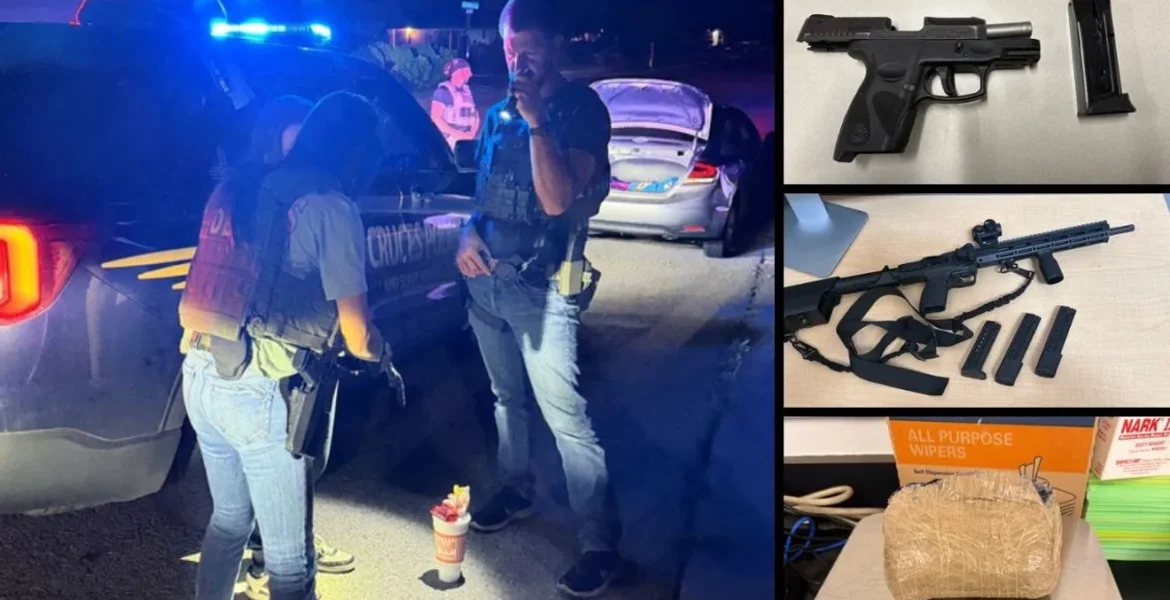
Las Cruces Operation Led by U.S. Marshals Ends With 237 Arrests, 17 Guns and Fentanyl, Methamphetamine, Cocaine Seized Across Five Weeks
LAS CRUCES, NM — A five-week fugitive operation in Las Cruces ended with 237 arrests and the seizure of drugs, firearms and two vehicles, according to the U.S. Marshals Service. Officials said the enforcement effort targeted fugitives and people tied to narcotics and weapons offenses.
The operation ran from Aug. 24 through Sept. 25 and was called Operation Triple Beam-Prolific. It was led by the U.S. Marshals Southwest Investigative Fugitive Team and brought together federal, state and local agencies working in the city and surrounding area.
What investigators recovered during the sweep
Along with the arrests, marshals reported recovering two vehicles and seizing 17 firearms. Officers also took in illegal drugs in several forms and quantities, including 54 grams of cocaine, 403.4 grams of methamphetamine and 110 grams of fentanyl.
The U.S. Marshals Service said the results reflected a broad enforcement push rather than a single case. The operation focused on fugitives and on disrupting the kinds of criminal activity that often move together, including drug trafficking and gun possession.
Agencies that joined the five-week effort
The U.S. Marshals Service said Operation Triple Beam-Prolific included the Las Cruces Police Department, the Office of the Third Judicial District Attorney, New Mexico State Police, the New Mexico Corrections Department, the FBI, the DEA, Homeland Security and the U.S. Attorney’s Office.
Officials described the operation as an example of how different agencies can combine resources to reach people who may be difficult for one department alone to locate. The marshals credited the multiagency setup as a key reason the sweep produced so many arrests in a relatively short period.
The operation also underscored the role of the Southwest Investigative Fugitive Team, a U.S. Marshals-led group that focuses on locating wanted people across the region.
State police and local leaders praise the partnership
New Mexico State Police Chief Matthew Broom said officers see the damage caused by criminal activity in Las Cruces and elsewhere in the state. He thanked the U.S. Marshals Service for leading the operation and said his agency would continue working with local, county, state and federal partners to protect communities.
Las Cruces Police Chief Jeremy Story said the sweep sent a message to people who cause violence and disorder that law enforcement will not tolerate it. He also said the effort showed residents that agencies at every level can work together to reduce crime and keep the city safer.
District attorney says arrests help prosecutions move forward
Doña Ana County District Attorney Fernando R. Macias said his office was grateful for the work of the U.S. Marshals and the collaborating agencies in locating and apprehending the people identified during the operation. He said arrests are necessary before many prosecutions can proceed.
Macias said the sweep will allow prosecutors to move forward in seeking justice and accountability. He also said the effort helps ensure that victims can receive justice when cases are built and presented in court.
The district attorney’s remarks tied the operation to the larger criminal justice process, from arrest to prosecution. Officials did not announce individual charges in the release describing the five-week effort.
Why officials point to interagency operations as important
In announcing the results, law enforcement officials said the operation highlighted the strength of partnerships between agencies. The stated goal was not only to make arrests but also to disrupt criminal activity tied to fugitives, drugs and guns.
The sweep adds to a pattern of cooperative enforcement actions in the region, where local agencies, state police and federal teams often work together on overlapping public-safety problems. Officials said that kind of coordination allows them to reach more people and address more threats at once.
For residents, the operation’s results offer a snapshot of what coordinated enforcement can produce over a short period: dozens of arrests, multiple firearms removed from circulation and several types of narcotics seized before they could move further through the community.
