
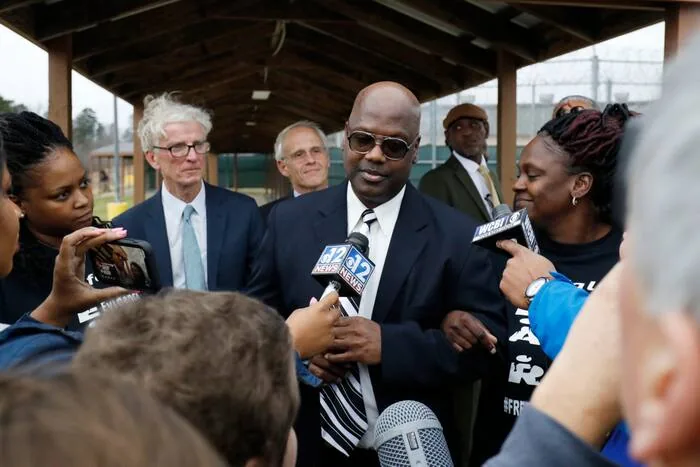
Curtis Flowers, Mississippi Man Whose Death Sentence Was Overturned by the U.S. Supreme Court, Dies at 56 After Decades-Long Wrongful-Conviction Fight
JACKSON, MS — Curtis Flowers, the Mississippi man whose capital conviction was erased by the U.S. Supreme Court, has died at 56.
His family confirmed that he died Wednesday at his home in Mississippi, according to attorney Rob McDuff, who represented him for years. No cause of death was given.
Flowers spent more than 22 years in prison after his arrest in a 1996 quadruple killing in Winona, a case that became a national test of race and jury selection in a death-penalty prosecution.
From a 1996 furniture-store shooting to six trials
Flowers was 26 when he was arrested several months after four people were shot to death inside a furniture store in Winona in July 1996. Prosecutors said he had been a disgruntled former employee seeking revenge against the store owner, who they said fired him and kept part of his pay to cover damaged merchandise.
Nearly $300 was reported missing after the killings. Flowers was tried six times over the years, with the case producing repeated reversals, mistrials and continuing legal battles.
Three convictions were overturned, including one in which a prosecutor improperly excluded Black jurors. Two other trials ended with hung juries. The case dragged on for more than two decades before it finally came apart in the state courts and then at the Supreme Court.
The Supreme Court ruling that changed the case
In 2019, the U.S. Supreme Court ruled 7-2 that Flowers had been denied a fair trial because Black prospective jurors were removed from the jury pool. Justice Brett Kavanaugh wrote the opinion.
The court focused on District Attorney Doug Evans’ repeated use of peremptory strikes against Black potential jurors. Across six trials, Kavanaugh wrote, Evans removed 41 of 42 prospective Black jurors.
The ruling made Flowers one of the most closely watched defendants in the country, because it put a spotlight on how jury selection can shape the outcome of a capital case and whether racial bias can distort the process before a trial even begins.
Freedom came after months of waiting
Even after the Supreme Court threw out his conviction and death sentence, Flowers did not immediately leave prison. He remained in custody for six more months because he was still under indictment.
A judge later set bond, and Flowers was released in December 2019. Mississippi then dropped the charges against him in September 2020, ending the criminal case that had followed him for most of his adult life.
In a statement at the time of his release, Flowers said he was “finally free from the injustice” that had kept him locked away for nearly 23 years. He credited the family that stood by him and said their support helped him believe that release would eventually come.
Wrongful-imprisonment payment and later lawsuit
In 2021, a Mississippi judge ordered the state to pay Flowers $500,000 for wrongful imprisonment, the maximum allowed under state law. The law can provide up to $50,000 a year for 10 years.
That same year, Flowers filed a lawsuit against Evans and three investigators who worked with the district attorney. The suit accused them of misconduct, including pressuring witnesses to invent claims about seeing Flowers in certain places on the day of the murders.
The lawsuit also alleged that investigators ignored other possible suspects. The legal fight kept the case in the public eye even after Flowers had been freed and the criminal charges were gone.
A case that reshaped race and jury selection
Flowers’ case left a lasting mark on Supreme Court law because it framed a clear warning about the exclusion of Black jurors in death-penalty trials. His legal team said Thursday that his name is now “etched into U.S. Supreme Court jurisprudence” because of the fight for a fair trial free from racial bias.
They also said they felt privileged to represent him for more than two decades and later honored to call him a friend. They remembered him at home, on his parents’ porch, singing in church and fishing in a local pond.
Evans retired in 2023 after more than 30 years as district attorney. Flowers, meanwhile, remained a symbol of how a single criminal case can expose deep problems in jury selection, wrongful imprisonment and the long road to exoneration.
